DORA

DORA compliance your management body can stand behind

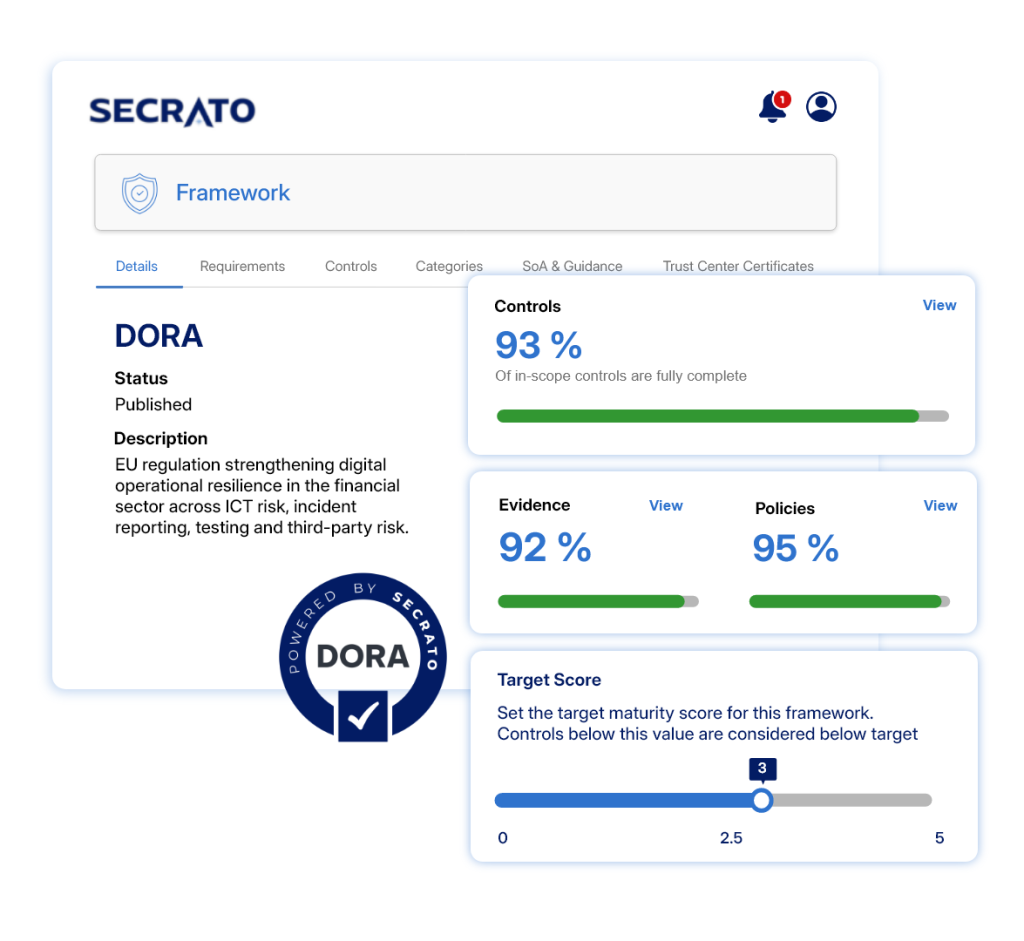
DORA holds financial entities to digital operational resilience. Secrato gives leadership visibility into status, risk posture and audit readiness, and keeps the ICT risk measures and evidence connected to the requirements they answer.

GDPR BY DESIGN
HOSTED IN BELGIUM
EU DATA SOVEREIGNTY
ENTERPRISE-GRADE SECURITY
ICT RISK MANAGEMENT

Connect ICT risks to their controls

See which controls address each ICT risk and which policies govern them, with ownership and status kept in view. Maintain these relationships in one connected environment instead of reconciling separate registers and records.

INCIDENT REPORTING

Keep evidence current and traceable

Maintain visibility into compliance status, risk posture and readiness as the programme evolves. Give the management body and reviewers a clearer view of the information needed to oversee DORA compliance.

GOVERNANCE & ACCOUNTABILITY

Give management a current view

Give the management body a current view of compliance status, risk posture and readiness. Assess requirements, organise findings and maintain the supporting records needed for internal and competent-authority review.

THE REST OF THE PLATFORM

More ways Secrato supports DORA

Beyond the core outcomes above, these capabilities support the wider DORA programme.

Compliance Engine

Manage requirements, controls, evidence, policies and status together, so teams can see how the programme stands without reconciling separate records.

Procedure Management

Maintain the procedures behind controls, policies and ICT risk measures so the operational detail stays current as the programme evolves.

Assessments

Scope, score and assign assessments against DORA requirements and controls, with responses connected to the records that support them.

Global Governance

Cascade group-level decisions across workspaces while allowing approved local deviations where individual entities require them.

API and integrations

Connect internal and external systems through APIs and integrations to support evidence collection and reduce manual chasing.

Trust Network

Present relevant security and compliance information to stakeholders through controlled public or gated access.

SUPPORTED FRAMEWORKS

One control. Multiple frameworks.

Many DORA measures overlap with controls already used for ISO 27001 and NIS2. Secrato’s Unified Control Library maps shared controls to the relevant requirements across frameworks, so teams can maintain and assess the control once while keeping DORA-specific obligations clearly visible.

Explore the other supported frameworks →

NIS 2

ISO 27001

CYFUN

GDPR

CRA

NIST CSF 2.0

PCI DSS

TISAX

ISO/IEC 42001

ANSSI

ISO 9001

ISO 14001

BSI

ISO 22301

IEC 62443

+ More and growing

FAQs for DORA compliance software

What is DORA?

DORA is the EU regulation for digital operational resilience, requiring financial entities to manage ICT risk, maintain resilience and meet incident-related obligations, with management bodies accountable for oversight. Regulation (EU) 2022/2554 (DORA) has applied since 17 January 2025. DORA also regulates financial entities’ relationships with ICT third-party service providers; direct EU-level oversight applies to providers designated as critical. As an EU regulation, it is binding in its entirety and directly applicable in all Member States.

DORA applies to the financial entities listed in Article 2(1), including, among others, credit institutions, payment institutions, investment firms, insurance and reinsurance undertakings, and crypto-asset service providers. It also contains specific provisions for ICT third-party service providers. The statutory scope is broader than these examples and should be assessed against the full Article 2 list. Certain financial entities that fall within Article 16 may apply a simplified ICT risk-management framework, subject to the categories and conditions in that Article and the applicable technical standards; eligibility is not determined solely by size or interconnectedness.

For a major ICT-related incident, the initial notification must be made as soon as possible, within four hours after the incident is classified as major and, in any event, no later than 24 hours after the financial entity becomes aware of it. Under the detailed reporting rules, the intermediate report is generally due within 72 hours of the initial notification and the final report within one month of the intermediate report, subject to the Regulation’s conditions.

Secrato supports DORA readiness by bringing ICT risks, controls, evidence and governance records into a connected view, making it easier to maintain oversight and demonstrate how the requirements are being addressed.

See your DORA programme in one connected view

Bring ICT risks, resilience measures, evidence and governance together. See how Secrato can support DORA as an ongoing governance programme rather than a recurring readiness exercise.

Secrato