GDPR compliance you can prove on demand
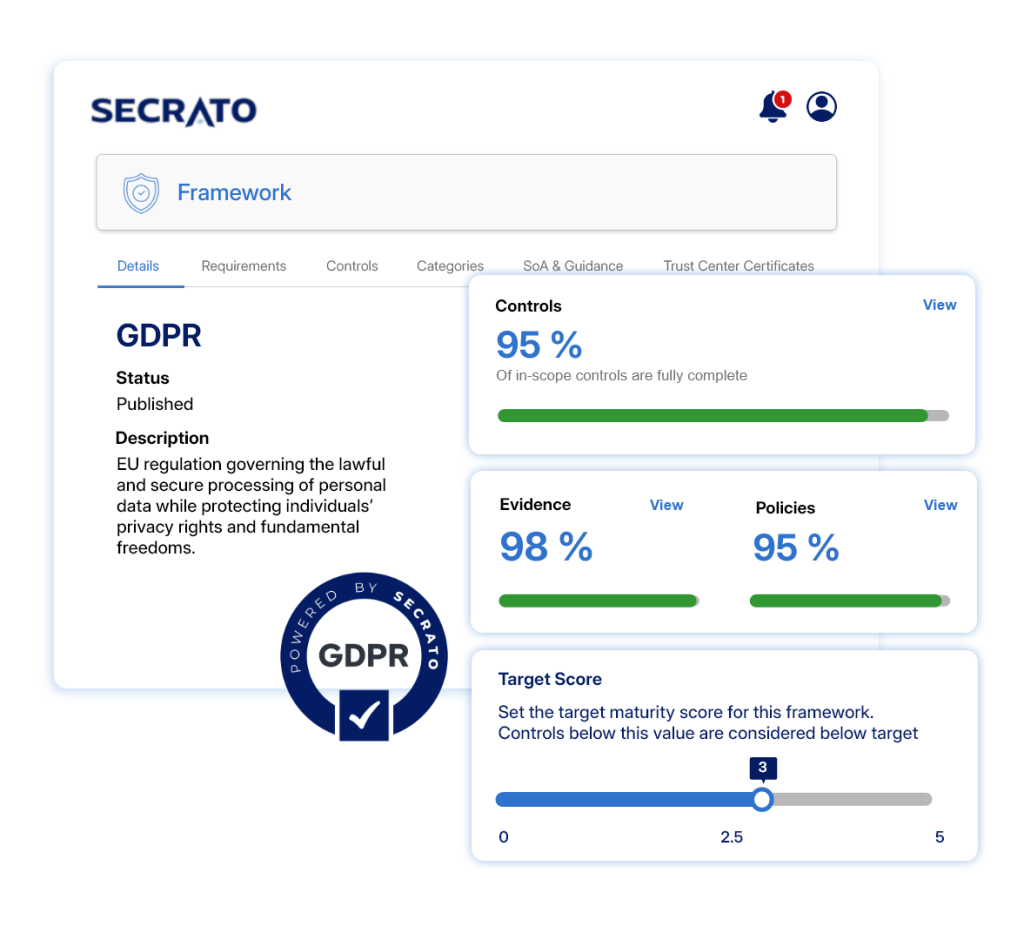
Under the GDPR, protecting personal data is only half the duty. You must prove, on request, that you do. Secrato connects the controls, policies and evidence that govern personal data to the requirements they satisfy, so accountability is documented rather than asserted.

Connect measures to requirements and risks
Map measures to the GDPR requirements they address and connect risks to the controls that treat them. Keep policies, treatment decisions and residual exposure linked so the reasoning behind your compliance posture remains visible.


Keep breach evidence ready
Maintain supporting evidence against the controls it substantiates and keep records current through automated collection and validation. When a personal data breach triggers notification obligations, teams can work from evidence already organised.
Demonstrate your security posture
Present selected security and compliance information to controllers and other authorised reviewers while maintaining controlled access. Keep compliance status, risk posture and readiness visible when customers or supervisory authorities need assurance.

More ways Secrato supports GDPR
Beyond the core outcomes above, these capabilities support the wider GDPR programme.
Compliance Engine
Manage requirements, controls, policies, evidence and status together, giving teams a clearer view of how governance measures are being maintained.
Policy & Evidence Management
Link policies and evidence that support GDPR controls and risks, so implementation is backed by maintained operational detail.
Assessments
Structure and assign assessments against requirements and controls, with responses linked to their supporting records.
Audit Hub
Organise evidence, review control readiness and manage findings when an auditor or supervisory authority requires assurance.
API and integrations
Connect relevant internal and external systems through APIs and integrations to support more current evidence records.
Trust Network
Share relevant security and compliance information with stakeholders through controlled public or gated access.
One control. Multiple frameworks.
Many GDPR security measures overlap with controls used for ISO 27001. The Unified Control Library maps shared controls across the relevant requirements, reducing duplicate assessment and evidence work without treating the frameworks as equivalent.
Explore the other supported frameworks →
NIS 2
ISO 27001
CYFUN
DORA
EU CRA
NIST CSF 2.0
PCI DSS
TISAX
ISO/IEC 42001
ANSSI
ISO 9001
ISO 14001
BSI
ISO 22301
IEC 62443
+ More and growing
FAQs for GDPR compliance software
What is GDPR?
The GDPR is the EU regulation governing the processing of personal data, with controllers accountable for demonstrating that its requirements are being met. The GDPR has applied since 25 May 2018. It regulates the processing of personal data, wholly or partly by automated means and, in defined cases, non-automated processing in a filing system. It imposes different obligations on controllers, joint controllers and processors.
Who does the GDPR apply to?
Subject to the GDPR’s material scope and exclusions, its territorial scope covers processing of personal data in the context of the activities of an establishment of a controller or processor in the Union, regardless of where the processing takes place. It can also apply to organisations outside the Union where their processing relates to offering goods or services to data subjects in the Union or monitoring their behaviour there.
Does the GDPR require breach notification within 72 hours?
A controller must notify the competent supervisory authority without undue delay and, where feasible, no later than 72 hours after becoming aware of a personal-data breach, unless the breach is unlikely to result in a risk to the rights and freedoms of natural persons. A processor must notify the controller without undue delay. Where a breach is likely to result in a high risk to data subjects, the controller must communicate it to them without undue delay, subject to the exceptions in Article 34(3).
How does Secrato support GDPR?
Secrato supports the governance and assurance side of GDPR by connecting data-protection risks, controls, policies and evidence, giving organisations a clearer and more traceable view of how their accountability obligations are being managed.
Make accountability easier to show
GDPR accountability depends on being able to demonstrate how data-protection measures are governed, not simply having policies in place. See how Secrato can bring the risks, controls, policies and evidence behind that accountability into a clearer, traceable view.